


Updated August 2026
Testosterone.
You’ve probably heard plenty about it.
It’s the hormone responsible for building muscle. It gives men their sex drive. It makes us competitive. Apparently, according to certain corners of social media, increasing testosterone levels will transform you into a muscular, confident, unstoppable version of yourself.
As Ron Burgundy might say, testosterone is kind of a big deal.
But there’s considerably more to testosterone than muscles, beards and libido.
Testosterone plays an important role in male development, sexual function, bone health, body composition and the production of red blood cells. And although we tend to call it the male hormone, women produce testosterone too – just in much smaller quantities.
Unfortunately, testosterone has also become an incredibly noisy subject.
Spend ten minutes online and you’ll encounter testosterone boosters, testosterone optimisation gurus, private TRT clinics, steroid discussions, declining testosterone claims and men convinced that feeling tired on a Tuesday afternoon means their testosterone levels have fallen through the floor.
I created Testosterone Truth because I think we need something in the middle.
I’m a qualified personal trainer rather than a doctor, and I’ve spent decades interested in strength, muscle, nutrition and male health. I’ve also spent thousands of hours reading and researching testosterone – including investigating my own testosterone levels.
My aim here isn’t to convince you to take testosterone.
Nor is it to convince you not to take testosterone.
If you’re learning about testosterone, I want to help you understand testosterone levels, what influences them and how the male hormone actually works in the body – without the hype that so often surrounds the subject.
So let’s start at the beginning.
Testosterone in 30 Seconds: Key Takeaways
If you only remember a handful of things from this guide, make them these:
- Testosterone is an androgen hormone produced primarily in the testes in men.
- It affects far more than muscle, including sexual function, fertility, bone health, body composition and red blood cell production.
- Testosterone levels naturally fluctuate and can change with age, health and other factors.
- Symptoms such as fatigue, low mood and reduced libido can be associated with low testosterone – but they can have many other causes.
- Proper assessment of suspected testosterone deficiency involves more than a single testosterone result.
- A low testosterone result tells you something may be happening. Understanding why it is low is arguably the more important question.
- TRT can be an appropriate medical treatment for testosterone deficiency, but it shouldn’t automatically be the first conclusion drawn from one low blood test.
Table of Contents
Learning About Testosterone: What Is the Male Hormone?
Testosterone is a steroid hormone belonging to a group of hormones called androgens.
In men, the vast majority of testosterone is produced in the testes, primarily by specialised cells called Leydig cells. Smaller amounts of androgens are also produced by the adrenal glands.
Women produce testosterone too, primarily through the ovaries and adrenal glands, although circulating testosterone levels are substantially lower than in men.
Testosterone production increases dramatically during male puberty and contributes to many of the changes we associate with developing from a boy into a man.
These include:
- Growth of the penis and testes
- Development of facial and body hair
- Deepening of the voice
- Increased muscle mass
- Increased bone mass
- Development of sexual function
- Increased production of red blood cells
- Changes in body composition
Testosterone continues to play important roles throughout adult life.
And here’s where things become more interesting.
Your testes don’t simply decide how much testosterone they’re going to make each morning.
There’s an entire hormonal communication system controlling testosterone production and testosterone levels.
How Does Your Body Produce Testosterone? (HPG Axis Explained)
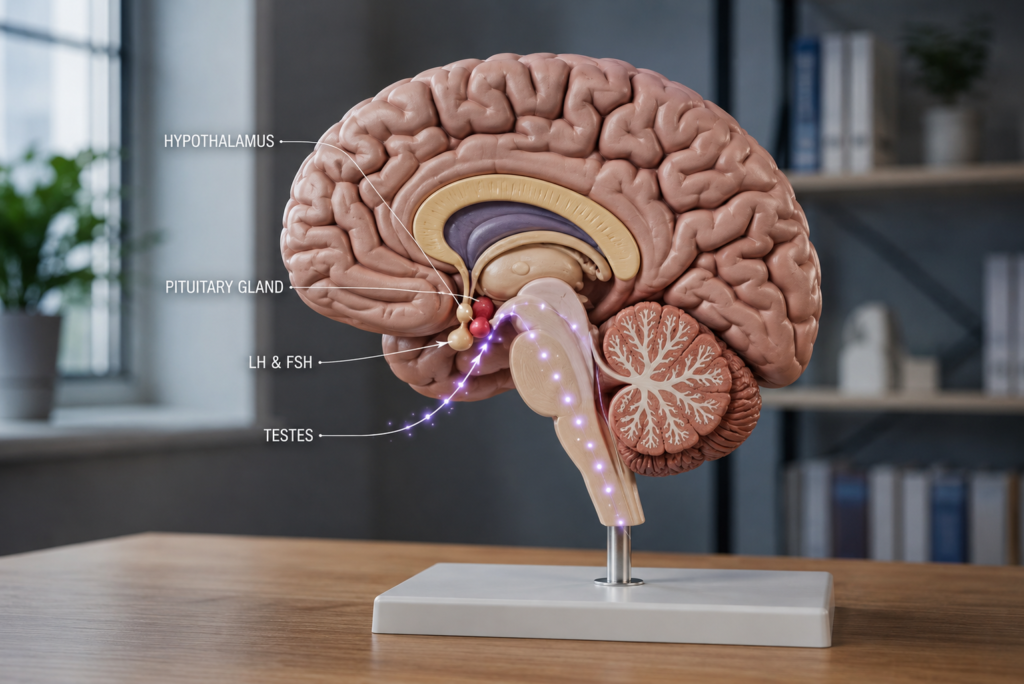
You can think of testosterone production as a conversation between your brain and your testicles.
This system is called the hypothalamic-pituitary-gonadal axis, thankfully shortened to the HPG axis.
The basic process looks like this:
Hypothalamus → Pituitary gland → Testes → Testosterone
Your hypothalamus, located in your brain, releases a hormone called gonadotropin-releasing hormone (GnRH).
GnRH signals your pituitary gland.
The pituitary then releases hormones including luteinising hormone (LH) and follicle-stimulating hormone (FSH).
LH travels through the bloodstream to the testes and essentially delivers the message:
“We need testosterone.”
Leydig cells inside the testes respond by producing testosterone.
FSH has an important role in male fertility and sperm production.
And there’s another clever part.
As testosterone levels rise, the brain receives feedback that sufficient testosterone is circulating and adjusts its signalling accordingly.
Your body therefore has its own feedback system designed to regulate testosterone production and maintain healthy testosterone levels.
Understanding this becomes particularly important when learning about testosterone and low testosterone, because primary hypogonadism and secondary hypogonadism have different underlying causes.
What Does Testosterone Do in Men? (Testosterone Function)

This is where testosterone earns its reputation.
It affects numerous systems throughout the male body.
Testosterone and Muscle Mass
Testosterone supports muscle protein synthesis and helps maintain muscle mass and strength.
It’s one of the reasons adult men generally possess considerably more muscle mass than women.
It’s also one of the reasons testosterone and its synthetic derivatives have been abused within bodybuilding and competitive sport.
But having higher natural testosterone levels doesn’t automatically turn someone into Arnold Schwarzenegger.
Training, nutrition, genetics, age, recovery and numerous other factors still matter enormously.
Testosterone and Bone Health
Testosterone contributes to maintaining bone mineral density.
Men with significant testosterone deficiency (low testosterone) can experience reduced bone density over time, potentially increasing the risk of osteoporosis and fractures.
Bone health probably isn’t the first thing most men associate with testosterone levels.
It’s nevertheless an important part of the picture.
Testosterone and Sex Drive (Libido)
Testosterone plays an important role in male sexual desire.
Low libido is therefore one of the symptoms that can be associated with low testosterone.
Notice my choice of words there:
Can be associated with.
A reduced sex drive doesn’t automatically mean you have low testosterone levels.
Stress, relationships, medication, poor sleep, depression, illness and numerous other factors can affect libido.
That’s going to become something of a recurring theme on Testosterone Truth:
Symptoms provide clues. They don’t provide a diagnosis of low testosterone.
Interestingly, research from the European Male Ageing Study found that sexual symptoms were among the symptoms most closely associated with low testosterone – particularly reduced sexual thoughts, erectile dysfunction and fewer morning erections.
That still doesn’t mean sexual symptoms automatically equal testosterone deficiency.
But it helps explain why clinicians look at the combination of symptoms and biochemical testosterone levels rather than either in isolation.
Testosterone and Fertility
Testosterone is involved in normal sperm production, working alongside other hormones including FSH.
There is an important distinction here.
Having healthy natural testosterone production supports male reproductive function.
Taking testosterone from outside the body – exogenous testosterone – can suppress the hormonal signals responsible for sperm production.
A review published in Translational Andrology and Urology states it very plainly:
“Testosterone replacement therapy inhibits spermatogenesis.”
Exogenous testosterone creates negative feedback within the HPG axis, reducing LH and FSH signalling and lowering the very high concentrations of testosterone normally maintained within the testes.
The result can be a substantial reduction in sperm production – and in some men, azoospermia, meaning no measurable sperm in the ejaculate.
This is one reason fertility needs serious consideration before starting testosterone replacement therapy (TRT).
I’ll cover TRT and fertility properly in a separate guide.
Testosterone and Red Blood Cells
Testosterone stimulates red blood cell production.
This is another example of why testosterone isn’t simply a “muscle hormone”.
Research has demonstrated that testosterone administration can increase haemoglobin and haematocrit.
It also explains why monitoring blood markers such as haematocrit can become important in men receiving testosterone therapy.
Testosterone and Body Composition

Testosterone influences the relationship between lean mass and body fat.
Clinically low testosterone levels can be associated with reduced muscle mass and increased body fat.
However, the relationship can work in both directions.
Obesity itself is associated with lower testosterone levels in many men.
That’s important because simply seeing a low testosterone result doesn’t necessarily tell you why testosterone is low.
Finding the cause of low testosterone matters.
Testosterone, Mood and Energy
Men with testosterone deficiency (low testosterone) may report fatigue, reduced motivation, low mood and difficulty concentrating.
But these symptoms are incredibly non-specific.
Someone sleeping five hours per night while working sixty hours a week might feel exhausted and unmotivated regardless of what his testosterone levels are doing.
That’s precisely why diagnosing low testosterone from a checklist on Instagram is a terrible idea.
Total Testosterone vs Free Testosterone (SHBG Explained)
This confused me when I first started properly learning about testosterone and testosterone levels.
You have total testosterone.
And then you have free testosterone.
What’s the difference?
Total testosterone represents the testosterone circulating in your bloodstream in different forms.
Much of it is bound to proteins, particularly:
- Sex hormone-binding globulin (SHBG)
- Albumin
A relatively small proportion circulates unbound. This is what we call free testosterone.
What Is SHBG?
Sex hormone-binding globulin (SHBG) is a protein produced primarily by the liver.
It binds strongly to testosterone and transports it around your bloodstream.
Albumin also binds testosterone, although less tightly.
Free testosterone isn’t bound to these proteins.
This means two men with similar total testosterone levels can potentially have different amounts of available testosterone depending partly on their SHBG levels.
Here’s my slightly ridiculous Ferrari analogy.
Imagine total testosterone represents all the fuel you own.
You’ve got plenty sitting there.
But what matters isn’t simply how much fuel you own – it’s how much is available to the Ferrari when it needs it.
That’s obviously an oversimplification of some complicated biology, but it illustrates why looking at one testosterone number doesn’t always provide the complete picture of testosterone levels.
Free testosterone can therefore be useful in certain circumstances, particularly where total testosterone and SHBG don’t provide a clear answer.
Society for Endocrinology guidance notes that when total testosterone is borderline, measuring SHBG and estimating free testosterone can provide additional diagnostic information.
What Is a Normal Testosterone Level? (Testosterone Levels Explained)
This sounds like it should have an incredibly simple answer.
Unfortunately:
“What is a normal testosterone level?”
is a surprisingly complicated question.
Different laboratories can use different assays and reference ranges for testosterone levels.
Age, health, timing of the blood test and other factors can also influence results.
There’s also a difference in how testosterone levels are commonly reported between countries.
Testosterone Levels in the UK
In the UK, testosterone is normally reported as:
nmol/L – nanomoles per litre
Testosterone Levels in the US
In the United States, you’ll commonly see:
ng/dL – nanograms per decilitre
This is why you’ll see someone online talking about having testosterone levels of “500”, while your UK blood test might show something like “17”.
They’re not experiencing testosterone levels thirty times higher than yours.
They’re simply using different units.
There isn’t one magic testosterone level at which every man above it feels fantastic and every man below it feels terrible.
That’s one of the most important things to understand when learning about testosterone levels.
Even the Endocrine Society emphasises the importance of using accurate assays and appropriate reference ranges rather than treating testosterone as one universal number.
Clinical interpretation of testosterone levels matters.
Testosterone Levels Change Throughout the Day
Your testosterone isn’t sitting at exactly the same concentration twenty-four hours a day.
Testosterone follows a daily rhythm and is generally highest during the morning, particularly in younger men.
Levels then tend to decline throughout the day.
This is one reason proper testosterone testing is generally carried out in the morning.
The Society for Endocrinology is remarkably specific about this. Its guidance states:
“Serum total testosterone levels should always be measured fasted before 11.00.”
It additionally recommends testing preferably following a good night’s sleep and not during intercurrent illness.
Testing conditions matter too. Sleep, food intake, acute illness and other factors can potentially influence the result.
It’s also one reason you should be wary of making major decisions based upon one randomly timed testosterone test.
If genuine low testosterone is suspected, diagnosis normally requires symptoms or signs consistent with testosterone deficiency alongside consistently low testosterone levels, confirmed with repeat morning testing.
The Endocrine Society recommends confirming the diagnosis by repeating a morning fasting total testosterone measurement.
One number shouldn’t define you.
And it certainly shouldn’t automatically result in a lifetime prescription.
Does Testosterone Decline With Age?

Generally, yes.
Testosterone levels can decline as men get older, although the rate and extent vary considerably between individuals.
This doesn’t mean every man reaching 40 suddenly develops “low testosterone”.
And there’s an interesting piece of research that puts this into perspective.
The European Male Ageing Study looked at thousands of men between 40 and 79.
Although low biochemical testosterone measurements were considerably more common, researchers estimated that only around 2.1% met their combined biochemical and symptom-based definition of late-onset hypogonadism.
Prevalence increased with age – from around 0.1% in men aged 40–49 to 5.1% among men aged 70–79.
Perhaps even more importantly, prevalence increased with body mass index and the number of existing health conditions.
That paints a considerably more complicated picture than:
“You hit 40. Testosterone crashes. Get on TRT.”
Nor does getting older automatically mean you require TRT.
Body composition, health conditions, medications and lifestyle can all influence testosterone levels alongside ageing itself.
When learning about testosterone and ageing, it’s therefore useful to separate:
“My testosterone levels aren’t as high as they were when I was 20.”
from:
“I have clinically diagnosed low testosterone (testosterone deficiency).”
They’re not necessarily the same thing.
What Is Low Testosterone? (Male Hypogonadism Explained)
The phrase low testosterone gets thrown around incredibly casually.
Clinically, the situation is more nuanced.
Male hypogonadism is a clinical condition involving impaired testicular function, which can result in inadequate testosterone production and/or impaired sperm production.
When specifically diagnosing testosterone deficiency, clinicians look for compatible symptoms and signs alongside biochemical evidence of consistently low testosterone concentrations.
This distinction matters.
A laboratory result labelled “low” isn’t automatically the same thing as a clinical diagnosis of hypogonadism.
The Endocrine Society’s clinical guideline puts this particularly clearly:
“We recommend diagnosing hypogonadism in men with symptoms and signs of testosterone deficiency and unequivocally and consistently low serum total testosterone.”
In July 2026, the Endocrine Society reiterated the point in an updated statement:
“Symptoms alone are not diagnostic of hypogonadism.”
That’s worth remembering the next time an algorithm presents you with a video explaining that being tired, irritable and carrying belly fat proves your testosterone has crashed.
Modern clinical guidance doesn’t recommend diagnosing hypogonadism because somebody has fatigue, belly fat and low motivation.
Nor should diagnosis generally be based on one borderline testosterone blood result.
Doctors look at the combination of:
Symptoms + signs + consistently low testosterone levels + investigation of the cause.
That last part is particularly important.
One of the recurring lessons when learning about testosterone is that a low number is only part of the story.
There are different types of low testosterone (hypogonadism), and understanding the cause matters.
Primary vs Secondary Hypogonadism (Causes of Low Testosterone)
There are two major categories worth understanding.
Primary Hypogonadism
Primary hypogonadism means the problem originates primarily within the testes.
The brain may be sending the appropriate hormonal signals, but the testes aren’t responding adequately, leading to low testosterone levels.
Potential causes include certain genetic conditions, testicular injury, infection and some forms of medical treatment.
Doctors can use other hormone measurements, particularly LH and FSH, alongside testosterone levels and the wider clinical picture to help determine what’s happening.
Secondary Hypogonadism
Secondary hypogonadism means the problem occurs higher up the signalling chain – involving the hypothalamus or pituitary.
The testes may retain the ability to produce testosterone, but they’re not receiving the appropriate stimulation, resulting in low testosterone levels.
This distinction matters enormously.
The Endocrine Society specifically recommends measuring LH and FSH in men with hypogonadism to help distinguish between primary testicular and secondary pituitary-hypothalamic causes.
Low testosterone is the result.
The next question should be:
Why are testosterone levels low?
Depending on the cause, further investigation may be required rather than simply replacing testosterone.
That’s one of the fundamental principles behind Testosterone Truth.
Don’t just chase the number.
Understand the cause of low testosterone.
What Are the Symptoms of Low Testosterone?
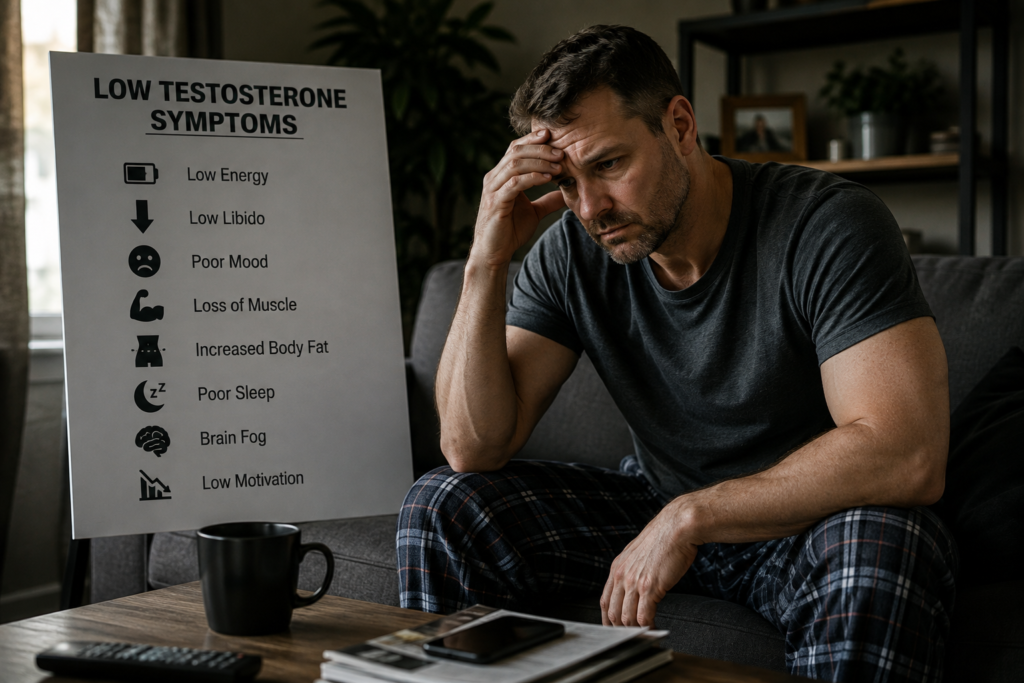
Possible symptoms and signs associated with low testosterone can include:
- Reduced libido
- Erectile difficulties
- Reduced spontaneous erections
- Reduced muscle mass
- Increased body fat
- Reduced bone density
- Fatigue
- Low mood
- Difficulty concentrating
- Reduced body or facial hair in some circumstances
- Fertility problems
Now read that list again.
How many could potentially be caused by something else?
Quite a few.
Fatigue?
Poor sleep can cause it.
Low mood?
Hundreds of potential causes.
Reduced libido?
Stress, medication, relationships and mental health can all contribute.
Loss of muscle?
Age, inactivity, inadequate protein and insufficient resistance training could all be involved.
This is where testosterone discussions online frequently go wrong.
A symptom checklist isn’t a diagnosis of low testosterone.
And that’s not merely my opinion.
As the Endocrine Society stated in 2026:
“Symptoms alone are not diagnostic of hypogonadism.”
How Do You Test Testosterone Levels?
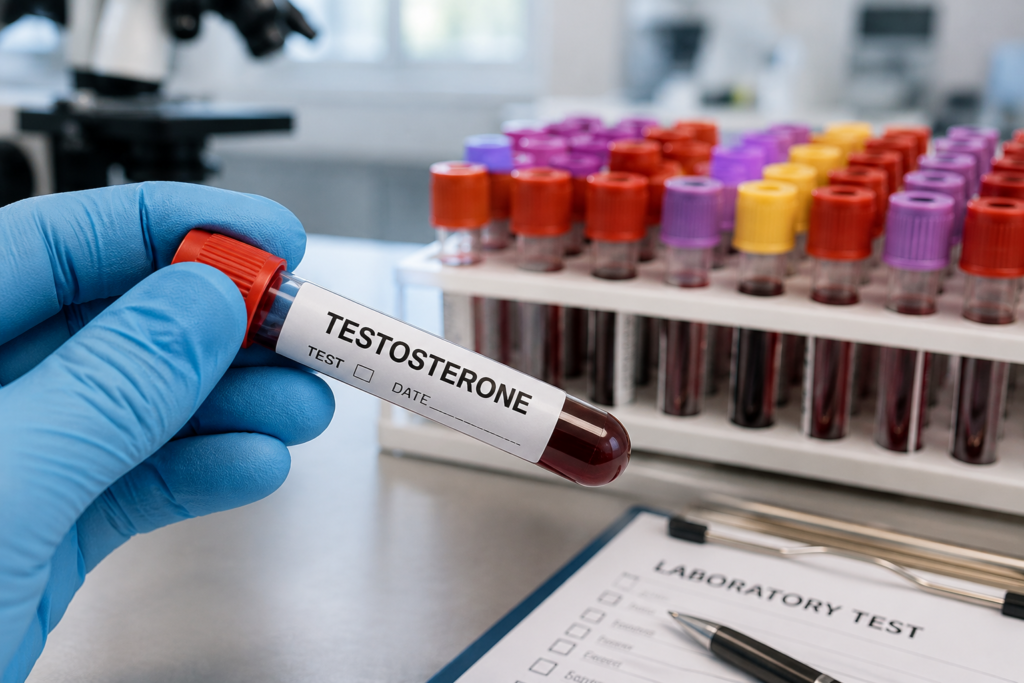
If you’re experiencing symptoms that concern you, speak to a qualified healthcare professional.
A blood test can measure your testosterone levels.
Where low testosterone is suspected, current endocrine guidance recommends confirming consistently low testosterone levels rather than relying upon a single measurement.
Testing is generally performed in the morning and repeat testing may be necessary.
For men following a conventional sleep-wake pattern, Society for Endocrinology guidance recommends measuring total testosterone fasted and before 11am, preferably following a good night’s sleep and not during an acute illness.
It also states that:
“Readings below the reference range on at least two different occasions support a diagnosis of hypogonadism.”
Depending on the circumstances, healthcare professionals may also investigate markers such as:
- LH
- FSH
- SHBG
- Prolactin
- Free testosterone or calculated free testosterone
Additional investigations can then be considered depending upon the results and your symptoms.
This is considerably more useful than simply asking:
“What is my testosterone level?”
If you’re learning about testosterone testing, the objective should be understanding what’s happening across the hormonal system and why testosterone levels are low.
My Own Experience With Testosterone Testing
This subject became more than academic for me.
In early 2023, I was experiencing a few symptoms that made me curious about my own testosterone levels.
Nothing dramatic.
But enough for me to get tested.
My total testosterone wasn’t clinically low, although my free testosterone was towards the lower end.
At that point I could have convinced myself that testosterone was responsible for every bad night’s sleep, rubbish gym session or afternoon when I couldn’t be bothered doing anything.
I didn’t.
I sought advice.
The recommendation I received was essentially that my results didn’t justify immediately jumping onto testosterone replacement therapy and that looking at modifiable factors first was reasonable.
That experience changed how I looked at the subject.
Testosterone shouldn’t become another number we’re obsessed with maximising.
More isn’t automatically better.
And TRT shouldn’t be viewed as some inevitable rite of passage when a man reaches middle age.
Equally, genuinely low testosterone shouldn’t simply be dismissed as “getting older”.
There is a sensible middle ground.
That’s what I’m interested in exploring.
A Brief History of Testosterone

We’ve understood testosterone for considerably less time than you might imagine.
And bizarrely, part of the story starts with chickens.
The Rooster Experiment
In 1849, German scientist Arnold Berthold conducted experiments involving roosters.
He observed that castration resulted in changes to characteristics and behaviour, while transplanting testicular tissue could prevent some of those changes.
The experiment helped establish the idea that the testes released something into the bloodstream capable of affecting the rest of the body.
They didn’t yet call it testosterone.
But the foundations had been laid.
Testosterone Gets Its Name
Fast-forward to 1935.
Researchers isolated the principal male sex hormone from testes and the name testosterone emerged.
Scientists Adolf Butenandt and Leopold Ruzicka subsequently made major contributions to understanding and synthesising sex hormones, work recognised with the 1939 Nobel Prize in Chemistry.
The ability to synthesise testosterone changed medicine – and eventually sport – forever.
From Medicine to Anabolic Steroids
Testosterone began being used therapeutically during the twentieth century.
Scientists also developed modified derivatives designed to alter testosterone’s anabolic and androgenic properties.
These became what most people think of when they hear:
“Anabolic steroids.”
And that’s partly where today’s confusion begins.
Is Testosterone a Steroid?
Yes.
Your body naturally produces steroids.
Testosterone is an anabolic-androgenic steroid hormone.
“Anabolic” broadly refers to tissue-building processes.
“Androgenic” relates to the development and maintenance of male characteristics.
But there’s an important distinction between:
Naturally produced testosterone
Medically prescribed testosterone replacement therapy (TRT)
and
Non-medical use of testosterone or other anabolic-androgenic steroids for physique or performance enhancement.
They overlap biologically.
They aren’t interchangeable situations.
Someone receiving medically supervised testosterone because his body cannot produce sufficient testosterone isn’t automatically equivalent to a bodybuilder using supraphysiological doses of hormones and anabolic steroids.
Context and dose matter.
I’ll explore this distinction properly elsewhere on Testosterone Truth.
What Is Testosterone Replacement Therapy (TRT)?
Testosterone replacement therapy (TRT) involves providing testosterone from outside the body to men with appropriately diagnosed low testosterone (testosterone deficiency).
Treatment can be delivered in several forms, including injections and transdermal preparations such as gels.
For men who genuinely need it, testosterone therapy can be an important medical treatment.
But starting TRT is also more complicated than:
Low testosterone level → testosterone injection → problem solved.
Treatment requires appropriate diagnosis, consideration of potential risks and benefits, and ongoing monitoring.
Fertility is particularly important because exogenous testosterone can suppress the hormonal signals involved in sperm production.
The Endocrine Society specifically recommends against starting testosterone therapy in men who are planning fertility in the near term.
This is why I don’t believe TRT should either be demonised or treated casually.
It’s medicine.
It should be treated like medicine.
Can You Increase Testosterone Naturally?
Sometimes modifiable factors contributing to reduced testosterone levels can be addressed.
That is not the same thing as claiming that every case of low testosterone can be “cured naturally”.
It can’t.
This distinction is incredibly important.
Body weight, energy availability, sleep, illness and certain medications can all potentially influence testosterone levels.
If an underlying modifiable factor is contributing to low testosterone, addressing it may improve the hormonal picture.
That distinction becomes particularly important when learning about testosterone optimisation, because supporting normal testosterone production and treating genuine hypogonadism are not necessarily the same thing.
Obesity provides a particularly important example.
Research from the European Male Ageing Study found that the prevalence of late-onset hypogonadism increased with increasing BMI and the number of coexisting health conditions.
In other words, the relationship between testosterone, ageing and health is considerably more complicated than simply watching testosterone fall as birthdays accumulate.
But no supplement, diet or exercise programme can magically repair every medical cause of testosterone deficiency.
I’ll explore the evidence surrounding naturally supporting healthy testosterone levels separately because it deserves considerably more attention than a few paragraphs here.
And yes – we’ll eventually tackle the enormous testosterone-booster industry too.
Spoiler alert:
I’m not expecting most supplement companies to send me Christmas cards afterwards.
Testosterone Isn’t About Chasing the Highest Level
This might be the most important point in this entire guide.
The objective isn’t to obtain the highest testosterone level physically possible.
It’s easy to fall into this trap.
If 15 nmol/L is good, surely 25 is better?
And if 25 is better, imagine how incredible 40 must be?
Biology doesn’t work like a video-game character where you continuously upgrade the testosterone statistic.
Testosterone is part of an enormously complicated endocrine system.
Too little can cause problems.
Artificially pushing androgen exposure far beyond normal physiological testosterone levels can create entirely different problems.
The objective should be healthy function, not winning a testosterone leaderboard.
When Should You Speak to a Doctor About Testosterone Levels?

If you’re experiencing persistent symptoms that could potentially be associated with low testosterone – particularly changes in libido, sexual function, fertility, energy or other unexplained symptoms – speak to your GP or another appropriately qualified healthcare professional.
Don’t diagnose yourself from this article.
And definitely don’t diagnose yourself from TikTok.
Proper assessment matters because many of the symptoms commonly blamed on low testosterone can have numerous other causes.
If testing does identify low testosterone levels, the next question shouldn’t simply be:
“How do I raise my testosterone?”
Ask:
“Why are my testosterone levels low?”
That question matters.
Understanding the underlying cause can help determine whether you’re dealing with a medical condition requiring treatment, potentially modifiable factors, or something else entirely.
Key Takeaways: Understanding Testosterone
If you’ve made it this far, you now know considerably more about testosterone than the average bloke.
And if you’re only beginning your journey of learning about testosterone, these are the points I’d particularly like you to remember:
- Testosterone is an androgen hormone produced primarily in the testes in men.
- Testosterone plays important roles in sexual function, reproduction, muscle mass, bone health and red blood cell production.
- Testosterone production is controlled by communication between the hypothalamus, pituitary gland and testes.
- Total testosterone and free testosterone aren’t the same measurement.
- SHBG influences how testosterone circulates in the bloodstream.
- Testosterone levels fluctuate throughout the day and are generally highest during the morning.
- Testosterone levels can decline with age, but getting older doesn’t automatically mean you have low testosterone.
- Symptoms associated with low testosterone aren’t unique to testosterone deficiency.
- Low testosterone shouldn’t normally be diagnosed from symptoms or one blood test alone.
- Primary and secondary hypogonadism have different underlying mechanisms and causes.
- TRT is a legitimate medical treatment for appropriately diagnosed testosterone deficiency, but it isn’t simply a lifestyle upgrade.
- Not every case of low testosterone can be fixed through lifestyle changes.
- Understanding why testosterone levels are low is more important than simply chasing a higher number.
Most importantly:
Don’t start with TRT. Don’t start with supplements. Don’t start by trying to “optimise” a number.
Start by understanding testosterone.
That’s exactly what Testosterone Truth is here to help you do.
Frequently Asked Questions About Testosterone
What is testosterone?
Testosterone is an androgen steroid hormone. In men, it is produced primarily by Leydig cells within the testes and plays important roles in male sexual development, reproductive function, muscle mass, bone health and red blood cell production.
Is testosterone only found in men?
No. Women produce testosterone too, although circulating testosterone levels are substantially lower than those typically found in men.
Where is testosterone produced?
Most testosterone in men is produced in the testes. Testosterone production is regulated through hormonal signalling involving the hypothalamus, pituitary gland and testes – collectively known as the hypothalamic-pituitary-gonadal (HPG) axis.
What is free testosterone?
Free testosterone refers to testosterone circulating in the bloodstream without being bound to proteins such as SHBG or albumin.
Free testosterone measurements or calculations can be useful in certain clinical circumstances, particularly when total testosterone and SHBG make interpretation difficult.
What are the symptoms of low testosterone?
Possible symptoms include reduced libido, sexual dysfunction, fatigue, changes in body composition, reduced muscle mass and low mood.
However, these symptoms can have many other causes and aren’t sufficient by themselves to diagnose testosterone deficiency.
How is low testosterone diagnosed?
Diagnosis generally involves symptoms or signs compatible with testosterone deficiency together with consistently low testosterone levels.
Repeat early-morning blood testing is normally used to confirm the result, followed where appropriate by further investigation to determine the underlying cause.
Does testosterone decrease as you get older?
Testosterone levels can decline with age, although there is substantial variation between men.
Having lower testosterone levels than you had in early adulthood doesn’t automatically mean you have clinical hypogonadism or require testosterone replacement therapy.
Is testosterone a steroid?
Yes.
Testosterone is a naturally occurring anabolic-androgenic steroid hormone.
That doesn’t mean your body’s natural testosterone production or medically indicated TRT is equivalent to the non-medical use of anabolic steroids for bodybuilding or performance enhancement.
Can you naturally increase testosterone?
Certain modifiable factors can affect testosterone levels, so addressing an underlying issue may improve testosterone levels in some men.
However, lifestyle changes cannot correct every cause of testosterone deficiency.
Does low testosterone automatically mean I need TRT?
No.
A low testosterone result needs to be interpreted alongside symptoms, repeat testing and investigation into the potential underlying cause.
Whether testosterone replacement therapy is appropriate is a clinical decision that should be made with an appropriately qualified healthcare professional.
Where to Go Next
Understanding what testosterone is gives us the foundation.
But learning about testosterone properly means going beyond the hormone itself.
The interesting part comes next.
Why do some men develop low testosterone? How much can sleep, body fat, diet, training and lifestyle genuinely influence testosterone levels? Which supposed “testosterone boosters” actually have evidence behind them? And when does TRT become a legitimate option rather than something that could potentially have been avoided?
Those are exactly the questions I’ll be exploring throughout Testosterone Truth.
No miracle supplements.
No anti-TRT agenda.
No pretending TRT is the answer to every problem a man experiences after 40.
Just an evidence-led look at testosterone, what influences it and the options available when something isn’t right.
If you’re learning about testosterone because you’re concerned about your own levels, curious about optimisation or simply want to separate the evidence from the noise, that’s what Testosterone Truth is here for.
Understand the cause. Understand your options. Then make an informed decision.
Sources & Medical References
The main clinical and scientific claims in this guide are supported by authoritative endocrine guidance and peer-reviewed research, including:
Society for Endocrinology. Male Hypogonadism and Ageing – guidance covering diagnosis, testing conditions, SHBG, secondary hypogonadism and age-related changes in testosterone.
Endocrine Society. Testosterone Therapy for Hypogonadism Guideline Resources – clinical recommendations covering diagnosis, repeat morning testosterone testing, investigation of primary and secondary hypogonadism, fertility and testosterone therapy.
Endocrine Society (2026). Statement on Testosterone Replacement Therapy – updated statement emphasising accurate diagnosis, symptoms plus consistently low testosterone measurements, appropriate testing and monitoring.
Wu FCW, Tajar A, Beynon JM, et al. Identification of Late-Onset Hypogonadism in Middle-Aged and Elderly Men.New England Journal of Medicine. 2010;363:123–135.
Crosnoe LE, Grober E, Ohl D, Kim ED. Exogenous Testosterone: A Preventable Cause of Male Infertility. Translational Andrology and Urology. 2013;2(2):106–113.
Further references will be added to individual Testosterone Truth guides as each subject is explored in greater depth.
About the Author
Matt Davies is a qualified personal trainer with decades of experience and personal interest in strength training, muscle development, nutrition and male health.
He created Testosterone Truth to provide clear, evidence-led information about testosterone, low testosterone, natural optimisation and testosterone replacement therapy without taking either an anti-TRT or pro-TRT position.
Matt is not a doctor and does not diagnose or treat testosterone deficiency. Where Testosterone Truth discusses diagnosis, testing or medical treatment, information is based on recognised clinical guidance and peer-reviewed research.
learn more about Matt and testosterone Truth.
Medical Disclaimer
Testosterone Truth provides educational information and isn’t a substitute for individual medical advice, diagnosis or treatment.
Information relating to testosterone testing, hypogonadism and testosterone replacement therapy is intended to help readers better understand the subject and should not be used to diagnose a medical condition or start, stop or alter treatment.
If you’re concerned about symptoms or your testosterone levels, speak to your GP or another appropriately qualified healthcare professional.